Showing posts with label GPSC Class- 1. Show all posts
GPSC Syllabus 2020 Gujarat Education Service class 2

GPSC Syllabus 2020 Gujarat Education Service class 2

GPSC Syllabus 2020 Gujarat Education Service class 2
Advertisement No: 125/2019-20 
Syllabus for Competitive Examination For the posts ofGujarat Education service class 2

1. How do Mutual Funds work?
A mutual fund is formed when an asset management company (AMC) pools investments from various individual and institutional investors with common investment objectives. A fund manager professionally manages the pooled investment by strategically investing in capital assets to generate maximum returns for the investors. Fund managers are professionals in the field of finance with an excellent track record of managing investments and have an in-depth understanding of markets. The fund houses charge expense ratio, which is the annual maintenance fee to manage investments of individuals. The investors make money through regular dividends/interest and capital gains. They can either choose to reinvest the capital gains via a growth option or earn a steady income by way of a dividend option.
2. Why should you invest in Mutual Funds?
Convenience
Investing in mutual funds is a paperless and straightforward process. Investors can monitor the market and make investments as per their requirements. Moreover, switching between funds and portfolio rebalancing helps to keep returns in line with expectations.
IMPORTANT LINK:::

GPSC Class 1,2 Study Material - Bhakti Andolan Part-2

The Bhakti movement originated in South India during the seventh to eighth century CE, spread northwards from Tamil Nadu through Karnataka and gained wide acceptance in fifteenth-century Bengal and northern India.
The movement started with the Saiva Nayanars and the Vaisnava Alvars, who lived between 5th and 9th century AD. Their efforts ultimately helped spread bhakti poetry and ideas throughout India by the 12th–18th century CE.
The Alvars, which literally means "those immersed in God", were Vaishnava poet-saints who sang praises of Vishnu as they travelled from one place to another. They established temple sites such as Srirangam, and spread ideas about Vaishnavism. Their poems, compiled as Alwar Arulicheyalgal or Divya Prabhandham, developed into an influential scripture for the Vaishnavas. The Bhagavata Purana's references to the South Indian Alvar saints, along with its emphasis on bhakti, have led many scholars to give it South Indian origins, though some scholars question whether this evidence excludes the possibility that bhakti movement had parallel developments in other parts of India.
Like the Alvars, the Saiva Nayanar poets were influential. The Tirumurai, a compilation of hymns on Shiva by sixty-three Nayanar poet-saints, developed into an influential scripture in Shaivism. The poets' itinerant lifestyle helped create temple and pilgrimage sites and spread spiritual ideas built around Shiva. Early Tamil-Siva bhakti poets influenced Hindu texts that came to be revered all over India.
Some scholars state that the Bhakti movement's rapid spread in India in the 2nd millennium, was in part a response to the arrival of Islam and subsequent Islamic rule in India and Hindu-Muslim conflicts. This view is contested by some scholars, with Rekha Pande stating that singing ecstatic bhakti hymns in local language was a tradition in south India before Muhammad was born. According to Pande, the psychological impact of Muslim conquest may have initially contributed to community-style bhakti by Hindus. Yet other scholars state that Muslim invasions, their conquering of Hindu Bhakti temples in south India and seizure/melting of musical instruments such as cymbals from local people, was in part responsible for the later relocation or demise of singing Bhakti traditions in the 18th century.
According to Wendy Doniger, the nature of Bhakti movement may have been affected by the "surrender to God" daily practices of Islam when it arrived in India. In turn it influenced devotional practices in Islam such as Sufism, and other religions in India from 15th century onwards, such as Sikhism, Christianity, and Jainism.

Klaus Witz, in contrast, traces the history and nature of Bhakti movement to the Upanishadic and the Vedanta foundations of Hinduism. He writes, that in virtually every Bhakti movement poet, "the Upanishadic teachings form an all-pervasive substratum, if not a basis. We have here a state of affairs that has no parallel in the West. Supreme Wisdom, which can be taken as basically non-theistic and as an independent wisdom tradition (not dependent on the Vedas), appears fused with highest level of bhakti and with highest level of God realization."
The Bhakti movement of Hinduism saw two ways of imaging the nature of the divine (Brahman) – Nirguna and Saguna. Nirguna Brahman was the concept of the Ultimate Reality as formless, without attributes or quality. Saguna Brahman, in contrast, was envisioned and developed as with form, attributes and quality. The two had parallels in the ancient pantheistic unmanifest and theistic manifest traditions, respectively, and traceable to Arjuna-Krishna dialogue in the Bhagavad Gita. It is the same Brahman, but viewed from two perspectives, one from Nirguni knowledge-focus and other from Saguni love-focus, united as Krishna in the Gita. Nirguna bhakta's poetry were Jnana-shrayi, or had roots in knowledge. Saguna bhakta's poetry were Prema-shrayi, or with roots in love. In Bhakti, the emphasis is reciprocal love and devotion, where the devotee loves God, and God loves the devotee.
Jeaneane Fowler states that the concepts of Nirguna and Saguna Brahman, at the root of Bhakti movement theosophy, underwent more profound development with the ideas of Vedanta school of Hinduism, particularly those of Adi Shankara's Advaita Vedanta, Ramanuja's Vishishtadvaita Vedanta, and Madhvacharya's Dvaita Vedanta. Two 12th-century influential treatises on bhakti were Sandilya Bhakti Sutra – a treatise resonating with Nirguna-bhakti, and Narada Bhakti Sutra – a treatise that leans towards Saguna-bhakti.
Nirguna and Saguna Brahman concepts of the Bhakti movement has been a baffling one to scholars, particularly the Nirguni tradition because it offers, states David Lorenzen, "heart-felt devotion to a God without attributes, without even any definable personality". Yet given the "mountains of Nirguni bhakti literature", adds Lorenzen, bhakti for Nirguna Brahman has been a part of the reality of the Hindu tradition along with the bhakti for Saguna Brahman. These were two alternate ways of imagining God during the bhakti movement.

GPSC BOOK LIST GPSC Class- 1,2 Study Material

GPSC BOOK LIST GPSC Class- 1,2 Study Material 

Latest Jobs : Click


Latest Material: Click


Latest Paripatra: Click

Latest Update : Click
We Are Daily Updated  Latest Gujarat & India Level All Types Government Jobs.We also Updated Various Exams schedule also. Also Answer key, Result, Question Paper, Merit and Selection Lists. We Also Provides GK, All types Most Important Study Materials Related General Knowledge, English Grammar, Gujarati Grammar, Maths, Science, History, Geography, Model Papers, Exams Old Papers, GK In Mp3 And Video Formats also.


GPSC Class-1 & Class-2 Syllabus
For All types COMPETITIVE EXAMS Like TET/TAT/HTAT, GPSC, Talati, Clerk, Police Constable And All Others. Also Good Study materials for Primary, secondary and High Secondary Students. Also Updated Primary School Latest  CIRCULAR Most Imp Bharat Na Itihas Na 250 Omr Questios Answers,Education News Paper News, Pagya Abhigam Latest Mobiles, Computer. And other Technology Tips Tricks with Images And Videos also.


In general, the higher the potential return, the higher the risk of potential loss.

Although some funds are less risky than others, all funds have some level of risk –
it’s never possible to diversify away all risk also

to gives you an extra ordinary benefit when you sit in exam. After seeing the exam syllabus you have got an idea of your exam paper already. It is also save your waste of time in exam. So take it seriously and improve your way to crack the examination.


Gujarat Public Service Commission time to time conducts the examination for fill up the vacant seats in GPSC. Preliminary exam is one of the most important exam of Gujarat Public Service Commission. Various district of Gujarat State candidates are appear in this exam in large scale.

So below we are going to provide you GPSC exam syllabus and exam pattern. You can practice and prepare to yourself with the help of this exam syllabus & pattern


So, Must Visit This Website Top-10.in Everyday For Latest Updates Jobs, Study Materials And General Information Updates.

GPSC Class- 1,2 Study Material - Indus Valley Civilization Part-2

GPSC Class- 1,2 Study Material - Indus Valley Civilization Part-2

Gujarati PDF File Is Available in The Bottom of the post


Mohenjo-Daro

 At least three major urban areas were located in the Indus River Valley:Mohenjo-Daro (also spelled Mohenjo-Daro), Harappa and Dholovira.
 Mohenjo-Daro (350 miles from Karachi) was the center of an ancient Indus civilization, and perhaps its capital. The largest of several wealthy cities in the Indus Valley, Mohenjo-Daro covered about one square mile, only a small potion of which has been excavated. A man-made, plateau-like hill, known as the citadel, was on one side of the city. About 300 structures have been excavated there.
 Mohenjo-Daro means "Mound of the Dead." The plateau-like citadel is believed to be have been the place where the rulers of the kingdom lived. The common people lived in the flatlands. At its height Mohenjo-Daro was home to maybe 80,000 people.
 Founded perhaps 6000 years ago, Mohenjo-Daro flourished between 2500 and 2000 B.C. along the irrigated banks of the Indus River when the climate wasn't as harsh as it is today. Only Egypt can lay claim to a civilization that was as old and as large.
 Exposing bricks found at Mohenjo-Daro was halted in the 1960s because the bricks began to crumble when exposed to the air. The problem is that the bricks have been soaked in ground water, leaving behind salt. Exposure to the sun and air draws out the moisture, leaving behind the salt, causing the bricks to crumble.

Harappa

 Harappa (127 miles south of Lahore) was another large Indus city. It may have been a twin capital with Mohenjo-Daro. Named after a nearby town and 400 miles from its sister city, Mohenjo-Daro, it extended over an area of 1.25 square kilometers (400 acres) and was home to 20,000 or more people and probably controlled a New-York-size area covering about 50,000 square miles.
 Harappa was located along the Rawa River, a tributary of the Indus, in a fertile flood plain. A reliable source of food helped the city take care of its own needs. Its location at the crossroads of important trade routes helped it prosper.
 The Indus Valley civilization is sometimes called the Harappan civilization because the first evidence of the Indus culture was found there. Archeologists have found remains of a village dating back to 3300 B.C. at Harappa. Potsherds found there have symbols that are similar to the Indus script. By 2200 B.C. Harappa covered 370 acres and was home to about 80,000 people, making it roughly equivalent on side to Ur in Mesopotamia.
 Harappa was discovered in 1921 and Mohenjo-daro was found a year later by Sir John Marshall. The sites have been continually excavated since then. British railroad workers scavenged large numbers of bricks from Harappa in the 1850s for ballast for their new tracks.
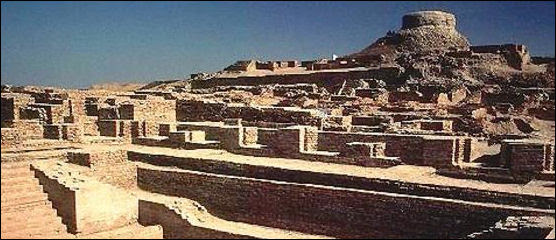
Mohenjodaro

Dholovira

 Dholovira (30 miles from the Pakistan border) is another 5000-year-old city in the desolate Rann area of Kutch in far western India that once stood on an island in a marsh, periodically flooded by the Arabian Sea.
 Dholavira was occupied between 2900 and 1500 B.C. with evidence of decline around 2100 B.C. Around 2000 B.C. the site was abandoned and the reinhabited around 1500 B.C. Tokens, seals and figurines that have been unearthed that are like those found at Mohenjo-Daro and Harappa.
 Scholars believe that Dholavira may have supplied salt to the Indus area and was once connected to the Arabian Sea by a channel or canal though no evidence of such a waterway has been found. Other large Indus settlements include Lurewala in the central Indus valley, Ganweriawala in the Cholistan desert and Kalibangan and Lothal in India. Some have suggested that this were independent city states. Other have argued they were provincial capitals under Harappa and Mohenjo-daro.

Mohenjodaro

Indus Language and the World's Oldest Writing?
 Some scholars believe the Indus people spoke a language that belongs the Dravidian family, which includes Tamil and about 25 other languages, many of them spoken in southern India.
 The language of Mohenjo-Daro is among the written languages that have not been deciphered. Other include the Minoan language of Crete; the pre-Roman writing from the Iberian tribes of Spain; Sinaitic, believed to be a precursor of Hebrew; the Futhark runes from Scandinavia; Elamite from Mesopotamia; the earliest Egyptian hieroglyphics; and Archaic Sumerian, the earliest written language in the world.
Important For You 
Gujarati SahityaCheck Gujarati Sahitya Book By GCERT
ComputerComputer PDF By Ice Rajkot
Bandharan Download bandharan Book By Ice Rajkot
BhugolGujarat Ni Bhugol By Angel Academy
 A 5,500 year-year-old inscription found on pottery in Pakistan in 1999 may be the world's oldest writing. A piece of pottery found at Harappa, dating between 3300 and 3000 B.C., contains branch-like lines that are similar to a trident-shaped symbol that appeared centuries later.
 The Indus people had a written language. Thousands of examples have been unearthed. Despite the best efforts by scholars, it is still undeciphered. This is one of the main reasons why so much about the Indus culture remains a mystery.
 Writing found on stone seals may have served as a form of personal identification. Seals sometimes had writing accompanied by figures of people, animals or mythical beats. Writing has also been found on button seals and inscribed shards.


GPSC Class 1,2 Study Material - Bhakti Andolan Part-1

GPSC Class 1,2 Study Material - Bhakti Andolan Part-1

GPSC Class 1,2 Study Material - Bhakti Andolan Part-1

GPSC Class 1,2 Study Material - Bhakti Andolan Part-1
The movement has traditionally been considered as an influential social reformation in Hinduism, and provided an individual-focused alternative path to spirituality regardless of one's caste of birth or gender.Postmodern scholars question this traditional view and whether the Bhakti movement ever was a reform or rebellion of any kind. They suggest Bhakti movement was a revival, reworking and recontextualisation of ancient Vedic traditions.
Samajikvigyan  PDF By ICE Rajkot
BandhranBandharan By ICE Rajkot
SportsRamat Gamat BY Ice Rajkot
BhugolGeography By Ice Rajkot
Scriptures of the Bhakti movement include the Bhagavad Gita, Bhagavata Purana and Padma Purana.

GPSC Class- 1,2 Study Material - Indus Valley Civilization Part-2

GPSC Class- 1,2 Study Material Part-1

GPSC Class- 1,2 Study Material - Indus Valley Civilization Part-1
Basic Samajik VigyanClick here
Talati Mantri 20 Model PaperClick here
Sanskrutik Varso By ICE RajkotClick here

Gujarati PDF File Is Available in The Bottom of the post

INDUS CIVILIZATION AND CULTURE

The Indus civilization is the oldest one known in Asia. Stretching from the Arabian Sea to the Himalayas and from the deserts of India to what is now Iran, it embraced 1,500 or so settlements and covered 280,000 square miles, an area roughly the size of Texas, or twice the size of ancient Egypt and Mesopotamia. [Source: Mike Edwards, National Geographic, June 2000; Santi Menon, Discover magazine, December 1998]
The Indus civilization was founded around 3000 B.C. and flourished from 2600 to 1900 B.C. Regarded as the world's oldest advanced civic culture, it is believed to have been a collection of states. Much about it is unknown because the civilization's written language has not been deciphered and no other culture with written languages described them (there was no mention of them in the Bible or the Vedas, which date back to 1500 B.C.). What is known has been determined from archeological excavations.
The Indus civilization was centered around Harappa and Mohenjo-Daro, two city-state civilizations that emerged around 3300 B.C. and endured until around 1500 B.C. Anthropologists regarded the Indus Valley cultures as one of the world's first civilizations along with Mesopotamia (founded in 3300 B.C), Egypt (founded in 3100 BC), and Yellow River Culture of northern China (founded shortly after 2000 BC). The Indus culture existed at the same time as these other cultures. Although trade existed between them. They appear to have developed independently and didn't have much influence on one another.
The Indus civilization was bound together by a common art and written language, and possibly by religion and trade as well. The Indus civilization cities were linked by the Indus river. The Indus River flows south from Karakoram and Himalayan Mountains through present-day Kashmir and Pakistan to the Indian Ocean. In the north it flows along the Pakistan-India border. Although the Indus civilization was scattered over a large area it was not large in terms of population. At its its height it was home to perhaps 400,000 people.
Early Indus History


Exactly when and where the Indus Civilization began and took root is still a matter of debate. Large and old settlements have been found in the Quetta, Loralai and the Zhob valleys in Baluchistan. Studies of these places seems to indicate that the people that lived in these places were semi-nomadic. The first permanent settlements are found closer to the flood plains of the great Indus River system.
Evidence of agriculture and urbanism dated to 7000 B.C."older than Mesopotamia---has been found at a site at Mehrgarth, an ancient settlement between the upland valleys of Baluchistan and the Indus flood plains. The settlement covered six hectares in 7000 B.C. and grew by 6000 B.C. to 12 hectares and had a population of maybe 3,000 people. The people that lived there raised wheat and barely and used domesticated cattle and water buffalo and hunted wild sheep, goats and deer. The dead were ritually buried, curled up on their sides, with some possessions, including turquoise beads from Turkmenistan,
The people of the Indus valley began trading on a wide scale at an early age. In the first known seafaring voyages, which may have taken place as early as 3500 B.C., Mesopotamians traveled across the Persian Gulf between Persia and India. See Indus and Mesopotamian Trade
Around 3500 B.C., permanent settlements began springing up over a wide area of the Indus River System. They are believed to have been settled by nomads that found advantages to living along rivers. The descendants of the Indus people were described in ancient Sanskrit texts as having dark skin. It is believed they spoke a Dravidian language. If this is true then the Indus Civilization is the ancestor the Dravidian civilization in southern India.
Important For You
Gujarati SahityaCheck Gujarati Sahitya Book By GCERT
ComputerComputer PDF By Ice Rajkot
Bandharan Download bandharan Book By Ice Rajkot
BhugolGujarat Ni Bhugol By Angel Academy
The earliest Indus settlements were strongly fortified neolithic villages destroyed by conquest. The people that lived here used copper and stamp seals and worshiped mother goddesses and horned deities. Archeologists date different groups and periods from this era based on different types of pottery. The fact that Indus Valley civilization settlements were built on the ruins of settlements of these cultures suggests that Indus Valley culture was imposed on them.